Why Cheap Molds Cost You More in the Long Run
What a Low-Cost Mold Actually Costs You
Micelli Chocolate Molds

When you're comparing chocolate molds, it's tempting to make the decision the same way you'd choose any other production supply: find the lowest price per mold and move on. A mold is a mold, right?
Not quite. The mold you choose doesn't just shape your chocolate — it shapes your production line, your waste stream, your brand presentation, and, if you're making THC or CBD-infused edibles, the dose in every single piece you sell. A mold that costs less up front can end up costing far more over a year of production, in ways that never show up on the original invoice.
Here's what actually separates a mold that pays for itself from one that quietly drains your margins.
The Real Cost of a "Cheap" Mold
The sticker price of a mold only tells you what you pay once. It doesn't tell you what you'll pay to keep production running.
Lower-cost molds — typically vacuum-formed or thermoformed from thin plastic sheets — are generally built to a lower standard of rigidity and heat tolerance than injection molded polycarbonate molds. In practical terms, that shows up as:
More frequent replacement. Thin-walled, thermoformed molds flex and crack under repeated use far more often than injection molded polycarbonate, which means reorders become a routine, recurring line item.
Cavity detail limitations. Due to the nature of the thermoforming process, designs requiring intricate detail, textures and crisp, sharp definition can become softened and lose definition during forming.
Inconsistent release and finish. A mold with an unstable or wobbly structure doesn't hold its shape run after run, which shows up as dull, inconsistent, or damaged finished pieces — and product you can't sell.
Limited heat and wash tolerance. Molds that can't handle repeated heating, cooling, and washing cycles wear out faster and are harder to keep production-ready.
Downtime. Every mold that warps, cracks, or gets pulled from rotation is a production interruption, and interruptions cost more than the mold itself.
None of this shows up in a per-unit price comparison. It shows up in your reorder frequency, your waste bin, and the hours your team spends managing a mold that can't keep up with your production schedule.
Injection Molded Polycarbonate vs. Vacuum-Formed Molds: What's Actually Different
The difference between a durable mold and a disposable one usually comes down to how it's made.
Injection molded polycarbonate molds are produced by melting polycarbonate resin and injecting it under extreme pressure into a precision aluminum die. That process produces a mold with a rigid, flat top surface, rigid side walls, and cavity detail that holds up to fine engraving, logos, and sharp edges. Because the material and the process are built for repeated use, injection molded polycarbonate molds are engineered to accept hundreds of heating and cooling cycles, stand up to automatic washing at higher temperatures and pressures, and run on automatic molding lines without the mold itself becoming the point of failure.
Vacuum-formed (thermoformed) molds are made by heating a plastic sheet — often PET or thin-gauge polycarbonate — and pulling it over a mold form using low pressure. That process is faster and cheaper to tool, which is exactly why these molds are less expensive to buy. But the tradeoff is structural: thermoformed molds are prone to an unstable, inconsistent top surface and flimsy, wobbly side walls, they tolerate far less repeated heating and cooling, they're more prone to warpage under wash and production cycles, and breakage — and the replacement orders that follow — is common. The low-pressure forming process also brings cavity detail limitations: a sheet stretched over a mold form can't hold the fine engraving, crisp logos, or sharp edge detail that injection molding achieves, so intricate designs come out softer and less defined.
For a low-volume, occasional batch, that tradeoff might be acceptable. For a chocolate brand running regular production, or a cannabis edibles manufacturer running defined, repeatable batches, it usually isn't.
For Artisan Chocolatiers: Durability Is a Brand Issue
If you're a craft chocolatier, mold durability isn't just an operations question — it's a brand question.
Every bar, piece, or tablet that comes out of your mold is part of how a customer experiences your brand. A mold with soft, inconsistent detail makes your logo look blurry instead of crisp. A mold that's starting to warp changes the way your chocolate releases, which shows up as dull finishes, air bubbles, or pieces that don't sit evenly in packaging. And a mold you have to keep replacing means more time spent managing supply instead of developing product.
A mold engineered to hold fine detail and consistent structure over hundreds of production cycles protects the thing you're actually selling: a professional, recognizable product that looks the same in run 200 as it did in run one.
For THC and Cannabis Chocolate Makers: Precision Is a Dosing Issue
For infused chocolate producers, mold quality isn't only about finish and durability — it's directly connected to dose accuracy.
Most state cannabis programs require infused edibles to meet a defined potency uniformity standard, testing each serving against the batch average within an allowed tolerance. Depending on the market, that tolerance can be tight, and a batch that fails uniformity testing can mean a failed lab result, a blocked release, or a costly reformulation — regardless of how correct the total batch potency was on paper.
Here's the part that's easy to overlook: chocolate is actually one of the more dose-consistent edible formats available, precisely because it's poured and cooled quickly, which locks the mixture in place before the cannabinoids have much chance to separate or migrate. That advantage only holds, though, if every cavity the mixture is poured into holds the same volume. Once your infused chocolate is properly homogenized, cavity-to-cavity dose consistency comes down almost entirely to cavity-to-cavity volume consistency.
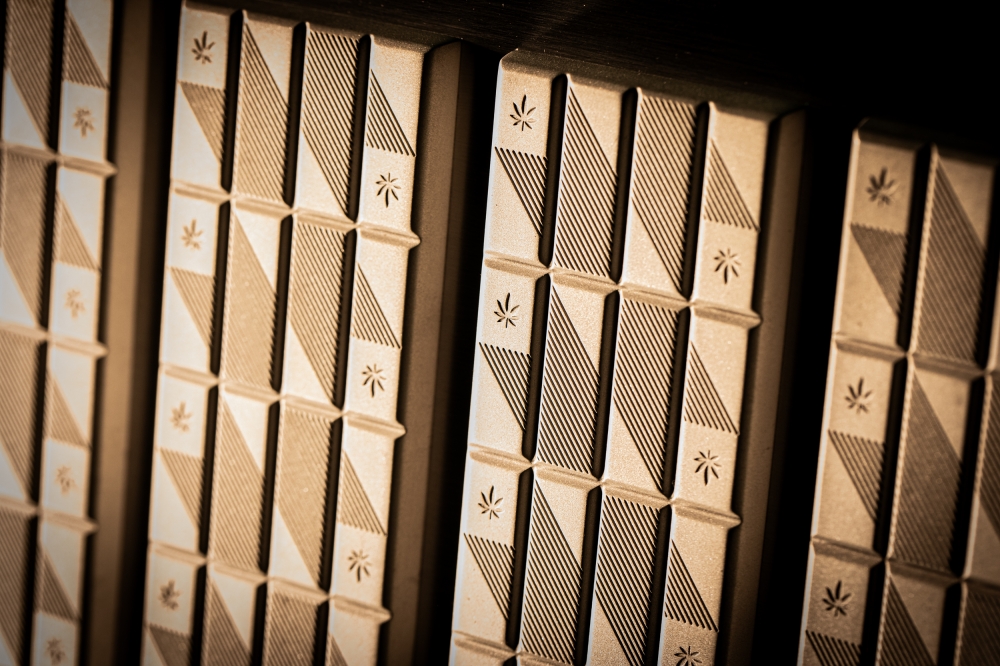
This is exactly where mold quality becomes a compliance and safety issue, not just a production-quality one. A thermoformed or vacuum-formed mold's less rigid structure and greater susceptibility to warping mean cavity depth and volume can drift from cavity to cavity, and from run to run, in ways that are difficult to detect until a batch is in lab testing. A precision injection molded cavity, by contrast, is built to hold the same volume, cavity after cavity, run after run — giving your formulation team a reliable, repeatable starting point for dose accuracy.
Mold precision doesn't replace proper homogenization, batch documentation, or lab verification — those remain essential parts of a compliant production process, and requirements vary by state, so any dosing and testing program should be built around your specific state's regulations. What precision molds do is remove one variable that's entirely within your control: whether every cavity in your production run is built to hold exactly what your formulation was designed to deliver.
Doing the Math on Long-Term Value
When you compare mold costs, it helps to compare total cost of ownership rather than sticker price alone. A lower-cost mold typically means a lower cost per unit today, in exchange for more frequent replacement orders, more production downtime, more scrapped or inconsistent product, and — for infused chocolate producers — a greater risk of dosing variance that can trigger failed testing or a recall.
A precision, injection molded mold typically means a higher cost per unit today, in exchange for far fewer replacements, more consistent release and finish across the life of the mold, less production downtime, and — for infused producers — a more reliable, repeatable cavity volume to build dose accuracy on.
Priced over a single order, the cheaper mold looks like the better deal. Priced over a year of production, it rarely is.
Micelli's Approach: Molds Built for the Long Run
Micelli Chocolate Molds has been engineering precision injection molded chocolate molds since 1947, for everyone from independent chocolatiers to industrial manufacturers, cannabis edibles brands, and nutraceutical confectionery producers. Every mold is built from polycarbonate using the same injection molding process and cavity precision, so your production can count on the same consistent release, the same fine detail, and the same reliable cavity volume, cycle after cycle.
A mold shouldn't be something you have to think about between production runs. It should simply perform, run after run, so you can focus on the product, the brand, and the customer in front of you.
Ready to Build Something That Lasts?
Whether you're scaling an artisan chocolate line or producing infused chocolate that has to meet strict dosing standards, the right mold is an investment in consistency you won't have to think twice about. Talk to a Micelli product specialist about custom, semi-custom, or stock polycarbonate mold options built for your production.